
III. Six Books on Light and Shade: 178.

The archive, offline Own the Wisdom of the Ages Every text in the library on a single USB drive. Read offline, cite freely, keep forever. No subscription required.
Buy USB Drive Now $127.00
III. Six Books on Light and Shade: 178.
178.
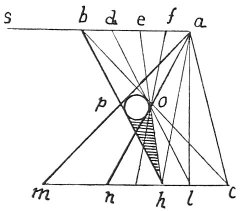
It can be proved why the shadow o p c h is darker in proportion as it is nearer to the line p h and is lighter in proportion as it is nearer to the line o c. Let the light a b, be a window, and let the dark wall in which this window is, be b s, that is, one of the sides of the wall.
Then we may say that the line p h is darker than any other part of the space o p c h, because this line faces the whole surface in shadow of 81
the wall b s. The line o c is lighter than the other part of this space o p c h, because this line faces the luminous space a b.
Where the shadow is larger, or smaller, or equal the body which casts it.
[First of the character of divided lights. 82
OF THE COMPOUND SHADOW F, R, C, H CAUSED BY A SINGLE LIGHT.
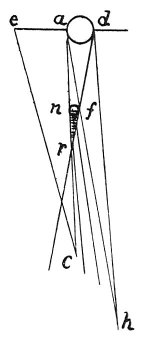
The shadow f r c h is under such conditions as that where it is farthest from its inner side it loses depth in proportion. To prove this:
Let d a, be the light and f n the solid body, and let a e be one of the side walls of the window that is d a. Then I say--according to the 2nd [proposition]: that the surface of any body is affected by the tone of the objects surrounding it,--that the side r c, which faces the dark wall a e must participate of its darkness and, in the same way that the outer surface which faces the light d a participates of the light; thus we get the outlines of the extremes on each side of the centre included between them.]
This is divided into four parts. The first the extremes, which include the compound shadow, secondly the compound shadow between these extremes.
Comments and social are coming soon
Reader conversations and shared activity will appear here.
186 of 1778 Chapter 0% Book 10% ~2 min left