
Chapter IX. Religion in Egypt and India

The archive, offline Own the Wisdom of the Ages Every text in the library on a single USB drive. Read offline, cite freely, keep forever. No subscription required.
Buy USB Drive Now $127.00
Chapter IX. Religion in Egypt and India
CHAPTER IX
RELIGION IN EGYPT AND INDIA
THE EGYPTIAN PANTHEON.--Many of our religious conceptions today are strong reflections of the old Egyptian. One might say indeed that our present day religion came to us from Egypt via the Jews. For that reason I have decided to give in this book an Egyptian Pantheon, which I have made up from the Egyptian Book of the Dead.
In many cases, it will be seen that the symbol of a certain belief or conception is represented by more than one god shown in the Pantheon. Under different guises and different names they, however, symbolize but a single conception. This comes from the scrambling of two sets of symbols when Upper and Lower Egypt were joined and became one kingdom.
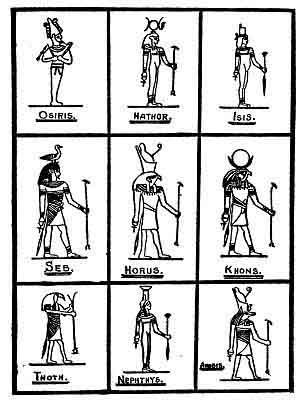
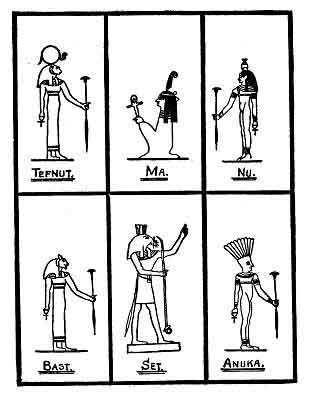
I am giving 24 figures placing them 6 on a page for easy reference. There are many others which I have not included; these are the principal ones only. I can only give an outline description, space will not permit of more. If more data is required about them, it will be found in many books written about Egypt.
Amen was the great god at Thebes, and was ad
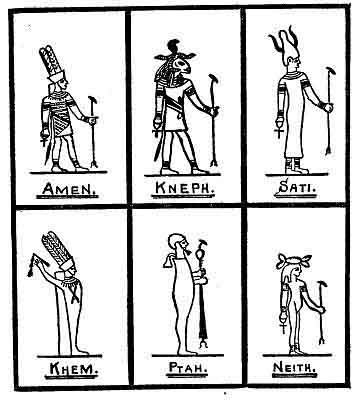
dressed as the "King of the gods." The Latinized form of the name is Ammon. The Romans identified him with Jupiter. The Greeks called him Zeus. He is also called "the hidden god." Before the 18th Dynasty he was worshipped at Thebes as Amen simply; but was afterwards merged into Amen Ra: "the hidden Sun." His color was a light blue.
Kneph was called "the moulder." He was known by the Greeks as Knonphis. Kneph is one of the oldest of the Egyptian gods and was especially worshipped in Nubia and Philae. His headdress is a ram's head surmounted with a solar disk and uraeus. Kneph is spoken of as "the soul of the Universe" and "The Creator." His color was bright green. Kneph's female consort was Sati.
Sati was the female consort of Kneph, and was looked upon as the Egyptian Juno. Her principal seat of worship was Elephantine, and throughout Nubia and Ethiopia. Her headdress was the Crown of Upper Egypt with a pair of cow's horns extending from it. Sati's color was a warm red human flesh color. I think that there can be no question but what Kneph and Sati were intended to symbolize the two principles of the Creator: male and female.
Khem was one of the deified attributes of the Creator. His special seat of worship was Chemmo (Panopolis). He was worshipped at Thebes and to some extent throughout Egypt. His headdress consisted of two straight feathers. He was generally colored blue.
"Ptah the Opener" was the oldest of the Egyptian gods. His principal seat of worship was at Memphis. Ptah was the symbol of the Creative power of the Deity. The Egyptians called him "the divine artificer." One of his symbols was the two-sided square.  He had many titles; one was: "The Father of beginnings." The Greeks considered Ptah the same as their Vulcan His name, peculiar to Memphis, was Ptah-Sokar-Osiris. The regular Egyptian name, however, was Ptah-Sekar-Usar. His color was blue. Ptah was without doubt the symbol of the Four Great Primary Forces--The Sacred Four.
Neith was the Egyptian Minerva, and was the goddess of the lower heavens. She is generally pictured holding up the heavens on her head. Neith was the special goddess at Sais. A corresponding symbol--a god upholding the heavens on his head-is found in the Maya of Yucatan. His color was blue. Neith was the symbol of The Four Great Pillars that upheld the Universe--The Sacred Four.
Maut called "the Mother" was the consort of Amen Ra at Thebes, and in this capacity represented the Mother of all: thus in Amen Ra and Maut we find another symbolization of the dual principle of the Creator. Maut was especially worshipped at Thebes in connection with Amen and at Chons with Amen Ra. She was also honored throughout Nubia and Ethiopia. Her color was warm, flesh colored red.
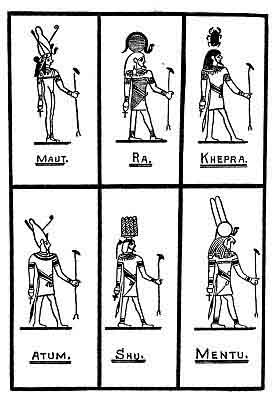
Ra was the name of the Sun as the monotheistic symbol of The Creator--monotheistic or collective. In the "Litany of Ra" he is called "the Supreme Power," "the only one," et cetera. To the initiated, he symbolized the power of the Deity; but to the populace he was stated to be a created god, the Son of Ptah and Neith. More errors have been made about this symbol by historians than any other symbol used by the ancients. His color was red.
Khepra. Although this symbol is found in the Egyptian Pantheon, it did not originate in Egypt but in the Motherland and was brought to Upper Egypt by the Nagas from the Motherland via Burma and India. The symbol is the Scarab beetle, which is placed over the head of a human figure in the Egyptian symbol. The Scarab symbolizes creative energy.
From the Papyrus Ani., King's Companion to Seti II: "Among the Egyptians, the Scarabeaus Beetle is no god, but one of the emblems of the Creator, because it rolls a ball of mud between its feet and sets therein its eggs to hatch. As the Creator rolls the world around, and causes it to produce life."
The foregoing passage is one that should be especially studied by students of the ancient past: for it shows us that the Egyptians up to the time of Seti 2nd understood the ancients' sciences and the workings of the Great Cosmic Forces, both of which are unknown to the scientists of today.
Before our sciences can advance to any perceptible
degree the present grotesque myths, the orthodox scientific teachings, must be abandoned and a study of the Four Great Primeval Forces made. On them the true sciences must be built up--sciences which teach us what life is and how it originates, the workings of the Four Great Forces throughout the Universe, with their origin, et cetera.
The vignette shows an engraving which I found in a very ancient Maya carving in India. It is thousands of years older than the first occupation of Egypt by man. The engraving is symbolical, as it shows the Creator symbolized by a Scarab, which is placed within rays of glory and rests on the symbol of Mu. Kneeling in adoration on either side of the rays is first man shown by his symbol Kėė the deer.
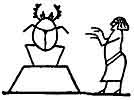
This vignette is taken from the Egyptian sacred book, the Book of the Dead. It symbolizes man in adoration of the Scarab Beetle as the symbol of the Creator. The Egyptian god Khepra undoubtedly comes out of the Nagas--Kėė
Atum or Turn was the god of the setting Sun: otherwise Amenti--the Sun below the horizon.
Shu was the firstborn of Ra and Hathor and brother of Tefnut. Shu was looked upon as a symbol of the Celestial Forces. His color was generally black.
Mentu was one of the deified attributes of the Sun and often bears the name Mentu-Ra. He was merely a phase of Ra who with Atum symbolized the rising and the setting Sun. Mentu was the special protector of Egypt.
Osiris was one of the oldest of the Egyptian gods. Later in this chapter I shall give the history of Osiris and show who he was. In the text of the Book of the Dead it is stated that he was the son of Seb and Nut.
Hathor was simply another name for Isis and is represented with the attributes of Isis. She was sometimes called Isis Hathor. Hathor personified Nature with all that was true and beautiful in it--the female principle of the Creator.
Isis is the goddess of the triad--Osiris, Isis and Horus. In the triad she was the wife of Osiris.
Horus was the son of Osiris and Isis and symbolized the Sun.
Seb was the father of Osiris and Isis and was called "the father of gods." Tefnut was his consort. In Seb and Tefnut again we find the dual principles of the Creator symbolized.
Khons was worshipped at Thebes, and, with Amen and Maut, formed the Theban triad. Khons symbolized the moon; he wears the disk and crescent moon.
Thoth was the god of writing, learning, and medicine. It was he who composed the early and most important portions of the Book of the Dead. Thoth is supposed to be the Egyptian Hermes.
Nephthys was the sister of Isis and Osiris and consort of Set.
Anubis was the god of embalming and embalmed his father Osiris.
Tefnut was the goddess of the rain and dew. She held a conspicuous place among the contemporary deities of Thebes.
Ma or Maat was the goddess of truth. She represents the truth and justice of the Supreme God.
Nu or Nut. Nut is the feminine form of Nu. Nu was the father, Nut the mother--the life givers.
Bast was the wife of Ptah and with their son Tum or Atum formed the great triad of Memphis.
Set was the son of Nut and brother of Osiris. According to the myth he murdered Osiris.
Anuka was the third member of the triad of Thebaid, composed of Khnum (Kneph), Sati and Anuka.
OSIRIS.--Osiris was one of the oldest of the Egyptian gods. His worship was universal throughout Egypt at all times. Osiris was the representative of all that was good.
The myths in Egypt about Osiris are bewildering. They claim that Osiris was once the monarch of Upper and Lower Egypt. It is claimed that Osiris was buried at Philae--other towns claim his remains. According to all these myths, Osiris must have lived since the union of Upper and Lower Egypt was accomplished under Menes about 5,000 B. C.
Against this we find that Thoth, the founder of the [paragraph continues]
Comments and social are coming soon
Reader conversations and shared activity will appear here.
13 of 15 Chapter 0% Book 80% ~7 min left