
Chapter V. Symbols Used In Religious Teachings

The archive, offline Own the Wisdom of the Ages Every text in the library on a single USB drive. Read offline, cite freely, keep forever. No subscription required.
Buy USB Drive Now $127.00
CHAPTER V
SYMBOLS USED IN RELIGIOUS TEACHINGS
THE symbols which were used in the religious teachings of early man are popularly known as the Sacred Symbols.
When symbols were first used it was to concentrate man's mind on the Infinite One, so that by keeping his eyes on the symbol no outside sights or sounds might call off his attention from the object of worship. Man was most carefully taught that the symbol itself was not to be worshipped; the symbol was only a picture to keep his mind from wandering. He was carefully taught that there was only One Deity, but that One Deity had many attributes which looked after health and strength, rain and sunshine, crops; in fact, after the whole welfare of mankind.
In the beginning three symbols only were used. When these were understood, they were compounded and others added, and as time grew so did the number of symbols, also their complexity, until we come down to Egypt about 3,000 or 4,000 years ago, when there was such a riot of symbols scarcely one temple understood the meaning of half the symbols used in another.
The three original symbols which I have referred to are: The Circle, The Equilateral Triangle and The Square.
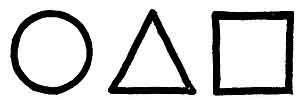
THE CIRCLE.--The Circle is a picture of the Sun and was the symbol of the Infinite One. As it embraced all of His attributes it was the Monotheistic Symbol. Being the Monotheistic Symbol it was considered the Most Sacred Symbol of all. According to legend, the Sun was selected for this symbol because it was the most powerful object that came within the sight and understanding of man at that time.
The circle having no beginning and no ending also symbolized:--everlasting, without end and infinity.
Before very long it is shown that the circle was being used to symbolize so many things that it became necessary to specialize the circle when using it as the Monotheistic Symbol of the Deity. The Nagas made an addition by placing a dot in the center of the circle. The Uighurs added a smaller circle within, making it a double circle.
Papyrus Anana: This is one of the most beautiful Egyptian writings that I have come across. Anana was chief scribe and king's companion to the gentle Seti II about 1320 B. C.
"Behold! is it not written in this roll? Read, ye who
shall find in the days unborn, if your gods have given you the skill. Read, O children of the future, and learn the secrets of the past, which to you is so far away, and yet in truth so near.
"Men do not live once only and then depart hence forever; they live many times in many places, though not always in this world. That between each life there is a veil of darkness.
"The doors will open at last, and show us all the chambers through which our feet wandered from the beginning.
"Our religion teaches us that we live on eternally. Now eternity having no end, can have had no beginning--it is a circle; therefore, if one be true, namely that we live on forever, it would seem that the other must be true also: namely, that we have always lived.
"To men's eyes God has many faces, and each one swears that the one he sees is the only true God. Yet they are all wrong, for all are true.
"Our Kas, which are our spiritual selves, show them to us in various ways. Drawing from the infinite well of wisdom that is hidden in the being of every man, gives us glimpses of the truth, as they give us, who are instructed, power to work marvels.
"The Spirit should not be judged by the body or the god by his house.
"Among the Egyptians the Scarabaeus Beetle is no god, but a symbol of the Creator, because it rolls a ball of mud between its feet and sets therein its eggs to hatch
as the Creator rolls the world around which seems to be round causing it to produce life.
"All gods send their gift of love upon this earth, without which it would cease to be. My faith teaches me more clearly perhaps than yours, that life does not end with death, and therefore that love, being life's soul, must endure while it endures.
"The strength of the invisible tie will bind two souls together long after the world is dead.
"The spirits or souls of one incarnation possibly may meet again in another incarnation, and may be drawn together as if by a magnet but for what cause neither knows.
"Man comes into being many times, yet knows nothing of his past lives; except occasionally some daydream or a thought carries him back to some circumstance of a previous incarnation. He cannot, however, determine in his mind when or where the circumstance occurred only that it is something familiar. In the end, however, all of his various pasts will reveal themselves."
Various forms and modifications of the Sun as Ra are to be found in the ancient writings.

Fig. 1. The Original Monotheistic Symbol of The Deity.
Fig. 2. A subsequent change made by the Nagas.
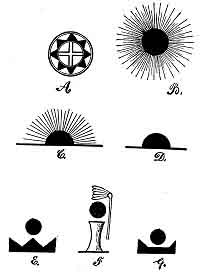
Fig. 3. A subsequent change made by the Uighurs.
Fig. 4. Part of the headdress of some of the Egyptian gods.
Fig. 5. This generally appears as a red sphere on tops of pillars and monuments to the dead.
The foregoing Suns are all the Monotheistic Symbol of the Deity and among the ancients was called Ra.
I will now take some pictures of the Sun appearing in ancient writings as the celestial orb and not as Ra the Monotheistic symbol.
Fig. A. Is an eight-ray'd Sun. This was Mu's symbol on her Royal Escutcheon. The name in the Motherland of the Sun as the celestial orb was--Kin. In Egypt the name was--Horus. In Greece--Apollo and in Babylonia--Belmarduk, et cetera.
Fig. B. A Sun with rays all around it represented the Sun at his meridian in mid-heavens.
Fig. C. A rising Sun with rays, half the orb above the horizon, was the symbol on the escutcheon of a colonial empire of Mu.
Fig. D. A Sun with half the orb above the horizon without rays had a dual symbolization. It was the symbol of the setting Sun. It was also the symbol of a colony of Mu, before it became a colonial empire.
Fig. E. The Lands of the West in darkness. The three-pointed figure is Mu's numeral symbol as the Lands of the West. The Sun above without rays says that no light reaches Mu--she is in darkness. A vignette from the "Book of the Dead."
Fig. F. The Sacrifice of Mu. The Lotus above is Mu's floral symbol; being shown withered and dying it symbolizes Mu as being dead. A rayless Sun stands between Mu and the altar; therefore Mu is dead in the region of darkness--on the altar as a sacrifice.
Fig. G. "Peaks only remain above the water." Mu is here depicted as being dead and in darkness with only points or peaks remaining above the water. Kin no longer shines upon her. Vignette from the Egyptian "Book of the Dead."
THE EQUILATERAL TRIANGLE.--The equilateral triangle has a dual significance, dependent upon where and how it is used. Its origin dates back as solving to primitive man the emersion of the three lands which formed the Land of Mu--the Lands of the West.
The Lands of the West consisted of a huge continental island and two small ones, separated from the big one by narrow seas, called in the Egyptian "canals." Tradition says that the big continental island was first emerged and that the two small islands were subsequently emerged at different periods. It was to explain this phenomenon, of the three lands coming up at different periods, that the triangle was selected.
The equilateral triangle has three equal sides joined to one another and forming a single unbroken line without ends.
It was pointed out to primitive man that it was the same Creator that raised all three lands, each land being raised by separate commands: Thus there were not
three Creators but only one. Apparently, to make it more understandable, each was raised by a separate attribute.
This formed the first Triune Godhead whereon have been built the enormous number of Pantheons that have permeated all ages. The conception of a Triune Godhead has been handed down from the beginning of religious teachings and still remains with us.
An equilateral triangle symbolized the Creator, and, as the Creator dwells in Heaven, the triangle must necessarily symbolize heaven also; for, where the Lord is, there is Heaven.
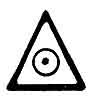
I find this verified among the Egyptian symbols, as the glyph shows. Here we find the Monotheistic Symbol of the Deity within the triangle-within Heaven. Wherever or whenever the equilateral triangle is met with in ancient writings or inscriptions, it is either in reference to the Triune Godhead, or Heaven, or both.
At the time of Confucius, the Chinese Sage, about 500 B. C., in place of the triangle the Chinese used a glyph in the form of the present-day capital Y. This they called: "the Great Term," "the Great Unite," "the Great Y." "The Y has neither body nor shape, all that has body and shape was made by that which has no shape. The Great Term or the Great Unite comprehends
three--One in three-and three in One."
THE FOUR-SIDED SQUARE.--The Four-sided Square completes the trilogy of the first and original Sacred Symbols.
The square was selected as a conventional symbol of the earth for apparently two reasons:--To prevent it from being confounded with the Sun whose picture was a circle; and for the purpose of teaching to primitive man the cardinal points North, South, East and West. Being drawn as a square gave the earth "four corners" which were to be explained as teaching developed. Later the four corners became the positions of the "Four Great Pillars," one of the many names given to the Four Great Primary Forces which emanate from the Creator. These Forces first evolved law and order out of chaos and darkness; then created the bodies of the Universe and all therein. They now continue and uphold the work that they have accomplished, hence the name of "Pillars" having been given to them. The next step was to appoint keepers for the Pillars. These were known as the Genii.
Apparently, when the meanings of the foregoing three symbols were learnt by primitive man, his next lesson was the compounding of these three symbols.
TRIANGLE WITH THREE STARS.--Fig 1. The triangle here symbolizes Heaven. The three stars within symbolize the three members of the Triune Godhead. The Triune Godhead dwells in Heaven.
TRIANGLE WITH FIVE STARS.--Fig 2. The triangle
symbolizes Heaven. The five stars within symbolize the full Godhead of Five, namely, the Deity and his Four Great Primary or Creative Forces. The Deity with His Great Forces dwells in Heaven.
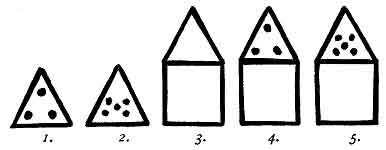
A TRIANGLE SURMOUNTING A SQUARE. Fig. 3. This glyph is composed of the four-sided square the symbol of the earth, with the triangle symbol of Heaven surmounting it; thus showing Heaven above Earth. Above, in this case, does not refer to altitude in any way. It means: that Heaven is on a higher plane, where life is more perfect than here on earth. Thus this symbol depicts Heaven as being more perfect than earth, more blissful and happy.
A TRIANGLE SURMOUNTING A SQUARE AND THE TRIANGLE HAVING THREE STARS WITHIN.--Fig. 4. In this symbol there is an addition of three stars placed within the triangle, symbolizing that the Triune Godhead is in Heaven, above the Earth. This symbol is to be seen on the end wall of an end room of an ancient temple in Uxmal, Yucatan. This temple has been called "The Temple of Sacred Mysteries" because there is an inscription on a wall stating that the people came from [paragraph continues]
Mu and brought the Sacred Mysteries with them. In the room where this symbol appears, the postulant received his second degree.
The temple was built about 11,500 to 12,000 years ago as shown by an inscription on its walls which states, "that this temple was erected as a monument to Mu."
A TRIANGLE SURMOUNTING A SQUARE AND THE TRIANGLE HAVING FIVE STARS WITHIN.--Fig. 5. As previously stated five stars symbolize the full Godhead of Five--The Deity and His Four Great Primary Forces. This symbol is to be seen on the end of the wall of the opposite room to the one previously mentioned in the Temple of Sacred Mysteries at Uxmal. Here the postulant received his third degree, and was then prepared to enter the Holy of Holies.
This ends the compounding of the three original symbols.
The Sacred Symbols:--The circle, triangle, square and pentagon became the foundation of the wonderful geometrical. knowledge attained in Mu and thoroughly entwined religion with science.
SYMBOLS OF MORTALITY.--A short space above the lintel of the entrance to the sanctuary of the Temple of Sacred Mysteries at Uxmal, Yucatan, is a cornice that surrounds the whole edifice. On it are sculptured the symbols of mortality which are many times repeated. The emblems of mortality occupied a very prominent place in ancient religion. It was extensively used by the Mayas, Quiches, Egyptians, Hindus and Babylonians
and was found in the writings and inscriptions of all ancient lands.
The emblems of mortality were used in the ancient religious ceremonies to impress upon the postulant what his end would be and the end of all mortality, and with this end in view impress upon him constantly the necessity of living a life that would bring no terrors when the soul releases itself from the body to pass into the world beyond.
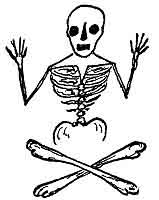
The Egyptian was a reflex of the Maya, and the Maya the teachings direct from the Motherland so that, from Egypt, we can get the original ceremonies with but immaterial changes. In the temple within the Great Pyramid was found in one of the chambers a sarcophagus with the emblems of mortality arranged alongside of it. The postulant was placed in the sarcophagus; here he was reminded that after his soul leaves his mortal body another life awaits him. This ceremony persists with the Freemasons today.
The TAU (Ta-oo).--The Tau is not only one of the most interesting, but it is one of the most ancient symbols, as it. is found repeatedly in the oldest writings of the Motherland.
It is the symbol of both resurrection and emersion. Emersion is really only a resurrection of land. I know of no country on the face of the earth today that has not been under water several times-thus each time it was emersed it was resurrected.
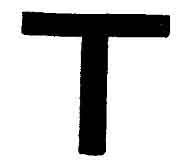
The name today is as it was in the Motherland--Tau; it was Tau then and it is Tau today. It is one of the very few words that has persisted through all time without a change in any way. The name means "the stars which bring the water." Ta--stars, and ha--water. The Marquesans today pronounce it "Ta-ha" (the pure Motherland pronunciation).
The Tau is the picture of the constellation, the Southern Cross, the most gorgeous group of stars appearing south of the equator. When the Southern Cross appeared at a certain angle over Mu, the rainy season commenced. The parched, dry land responded to the moisture from above. Leaves, flowers and fruit sprang forth upon tree and shrub. Seeds in the ground, that had been lying dead, germinated and sprang forth into life, enriching
the land with golden grain. Mu became the land of plenty. Life had been resurrected.
Comments and social are coming soon
Reader conversations and shared activity will appear here.
9 of 15 Chapter 0% Book 53% ~12 min left